

Dr. William Cohn and the serious business of not taking yourself too seriously
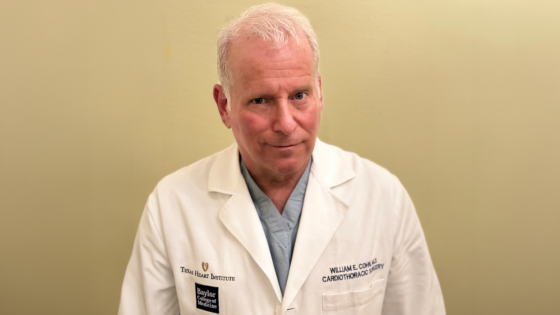
Ask around about William “Billy” Cohn, M.D. ’86, Res. ’91, Res. ’93, Hon. Ph.D., and two types of stories surface. The first involves over 120 patents, several startups and developing what might become the world’s first permanent total artificial heart. The second involves a surgical resident roller-skating through the halls of Ben Taub Hospital with a rabbit in his arms, the same trainee who once led his band into a local mall for an impromptu performance, which ended abruptly when mall authorities informed them that a booking was required.
The longer you listen, the clearer it becomes that these are the same story.
Dr. Cohn, recipient of the 2026 Baylor College of Medicine Alumni Lifetime Achievement Award, has spent his career proposing things that sound outlandish right up until he accomplishes them. A Houston native, he completed his undergraduate studies at Oberlin College. In 1982, he returned home for medical school and surgical training at Baylor, where he served as the last chief resident under Michael E. DeBakey, M.D.
His career as a surgical inventor began with a longstanding practical problem: beating-heart bypass surgery was possible, but operating on a constantly moving heart made the procedure technically challenging, and no one had built the right tool for it.”
His solution was the first self-retaining coronary artery stabilizer, which made beating-heart bypass more widely accessible and was used in over 250,000 procedures. More inventions followed, including:
- The NextStitch valve suture system, which helps surgeons implant replacement heart valves with greater speed and precision.
- The SentreHeart LARIAT, which reduces stroke risk in patients with atrial fibrillation by closing off the left atrial appendage and preventing it from becoming a source of blood clots.
- The WavelinQ EndoAVF System, a minimally invasive technology that allows physicians to create dialysis access from inside the blood vessels rather than through traditional surgery.
A much bolder problem inspired Dr. Cohn’s most ambitious project: the quest to create an artificial heart. Artificial hearts had existed for decades but only as temporary fixes before receiving heart transplants. Their valves and flexible membranes wore out under the strain of beating roughly 100,000 times a day. Patients faced clotting, infection and devices that could not adapt to varying activity levels.
Dr. Cohn, along with O. H. Frazier, M.D. ’67, Res. ’68, Res. ’74, Baylor’s 2024 Alumni Lifetime Achievement Award winner, decided to reimagine the problem. What if the goal wasn’t to recreate the heart but to build the simplest machine that can sustain healthy circulation?
Dr. Cohn and Dr. Frazier spent years testing paired rotary blood pumps, which produce continuous flow and no pulse. In 2011, they implanted the world’s first rotary artificial heart in a human patient. That milestone drew Australian engineer Daniel Timms, Ph.D., to Houston. Their collaboration produced BiVACOR, an artificial heart with a single magnetically levitated moving part. It is an elegant design that reduces friction, mechanical wear, blood-cell damage and clot formation while providing continuous circulation. It has been implanted in 15 patients as part of an FDA early feasibility study. It may become the world’s first permanent artificial heart.
In addition to his clinical career and medical innovations, Dr. Cohn mentors the next generation of Baylor surgical residents and Rice engineering students, offering lectures on what he calls “do-it-yourself innovation.” During these lectures, he demonstrates how some of medicine’s most advanced devices began as homemade contraptions to lower the perceived barriers to innovation that many young trainees face.
His message to the next generation is clear: you do not need to be anointed to try something daring. Dr. Cohn has been teaching it since his residency, when he roller-skated past the rules at Ben Taub, and he’s been doing the same with cardiovascular medicine ever since.