

Getting to know the leader guiding Baylor College of Medicine into its next era
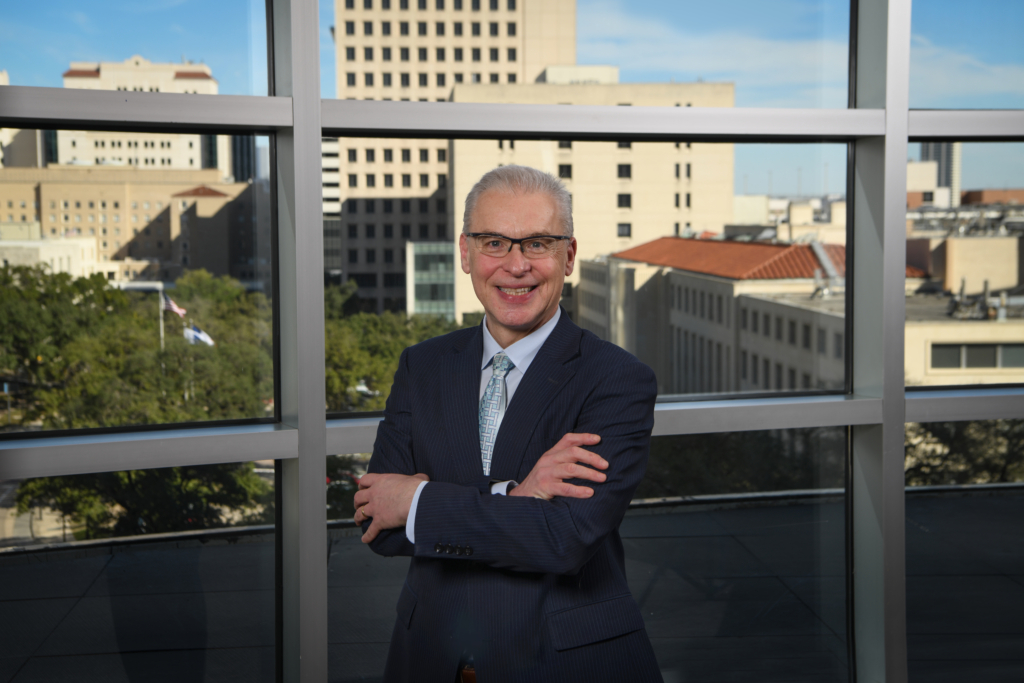
Since joining Baylor College of Medicine as President, CEO and Executive Dean, Jakub Tolar, M.D., Ph.D., has quickly embraced the institution’s culture of excellence, collaboration and service. In this Q&A, he shares what drew him to Baylor, the opportunities he sees for advancing research, education and patient care, and how Baylor’s longstanding partnership with its donors and community continues to fuel innovation and impact. He also offers a more personal perspective on the experiences and values that have shaped his approach to leadership.
As you begin your tenure as President, CEO and Executive Dean of Baylor College of Medicine, what led you to Baylor, and what excites you most about Baylor’s future?
Baylor College of Medicine is recognized for its focus on excellence, and I have always viewed Baylor as being at the top of the pyramid in academic medicine. The opportunity to lead this institution filled with nationally and internationally recognized faculty along with outstanding staff and trainees was a significant attraction for me. The community support was also important, and as I learned more, I found that Baylor is deeply imbedded in the Houston community and in communities throughout Texas.
The possibilities for growth and new programs at Baylor are endless. Our work in basic and clinical research is exciting and new discoveries are happening every day. Baylor’s educational programs are innovative, particularly the K-12 STEM+M programs that have expanded to school districts from West Texas to South Texas.
During your first few months here, what have you learned about Baylor that has impressed or inspired you?
The faculty, staff and trainees at Baylor are phenomenal. The culture of collaboration and commitment to excellence is evident throughout the Baylor community. I am also impressed by our affiliated hospitals that are nationally recognized for delivering outstanding patient care. Many Baylor faculty and staff are integrated within these affiliates caring for patients and training Baylor students, residents and fellows to be outstanding clinicians and leaders in healthcare.
Baylor College of Medicine is a health sciences university that creates knowledge and applies science and discoveries to further education, healthcare and community service locally and globally. What aspects of the mission statement resonate with you?
Baylor’s mission reflects the very essence of academic medicine. Quite simply, it means that science saves lives. We advance that mission through innovative research, exceptional patient care and educating the next generation of healthcare professionals and scientists.
Looking ahead, what opportunities do you see for Baylor to make an even greater impact on human health locally, nationally and globally?
Improving health in our Houston community and throughout the world has been a priority at Baylor for many years. Technology has already helped us expand our reach to individuals and communities beyond Houston with telehealth and telepsychiatry programs. I believe there are opportunities to expand our K-12 programs to other parts of Texas and even nationally.
With our Board of Trustees and leaders at Baylor, I want to identify opportunities for growth locally, nationally and globally and then develop a plan.
Philanthropy has helped shape Baylor throughout its history. What message would you like to share with our donors and supporters who invest in the institution’s mission areas of education, research, patient care and community outreach? What do you hope they will feel when they see the impact of their generosity at Baylor?
What makes Baylor special is the enduring partnership Baylor has had with the Houston community for more than 80 years. The generosity of our donors and supporters helped make Baylor one of the nation’s 16 top tier medical schools. We are also ranked 23rd in National Institutes of Health research funding, placing Baylor among the top 15% of medical schools. With each medical and scientific advancement we make, each patient we serve and each graduate who begins their career, I want our donors to recognize the role their philanthropy played in making our successes a reality. I want them to be proud of the investment they are making in Baylor College of Medicine and know how much we respect and honor them for their partnership.
Every leader brings unique experiences and perspectives to the role. What personal or professional experiences have most shaped your approach to leadership?
In medicine, the most influential teachers are patients. My medical specialty is in oncology and bone marrow transplant, and my patients were among the most vulnerable but also among the strongest. They taught me the importance of courage, moral consistency and active responsibility.
Patients helped me develop a greater understanding of human nature and the many ways people process information, uncertainty and adversity. Strong leaders know how to answer difficult questions and how to deliver messages with honesty and compassion, understanding that the answers may not be what a person expects.
I am an avid reader, and I have drawn inspiration from historical figures in science, public service, philosophy and the arts, including Gregor Mendel, Peter Medawar, Thomas Jefferson, Winston Churchill, Johann Sebastian Bach, Rembrandt, Maria Callas, Leo Tolstoy, Aristotle and Albert Camus. In unique ways, each demonstrated the power of curiosity, resilience, creativity and principled leadership.
Beyond your professional achievements, what would you like the Baylor community to know about you as a person?
My family is my rock. My wife and I have three children and four grandchildren, and they are our pride and joy. I am an avid reader, we enjoy museums, opera and music. Most of all, we are looking forward to exploring Texas, which is about three times as large as Minnesota.