

Stop Alzheimer’s Now partners with Dr. Benjamin Deneen on a new direction in Alzheimer’s research
Over the past century, Alzheimer’s disease research has progressed from its discovery in 1906 to today’s focus on precision medicine and early prevention. At Baylor College of Medicine, Benjamin Deneen, Ph.D., professor and Dr. Russell J. and Marian K. Blattner Chair in Neurosurgery and director of the Center for Cancer Neuroscience, is advancing a promising new approach to understanding and treating the disease. His work recently received a $100,000 grant from Stop Alzheimer’s Now, supporting innovative, cure-focused research aimed at improving the future for patients and families affected by Alzheimer’s.
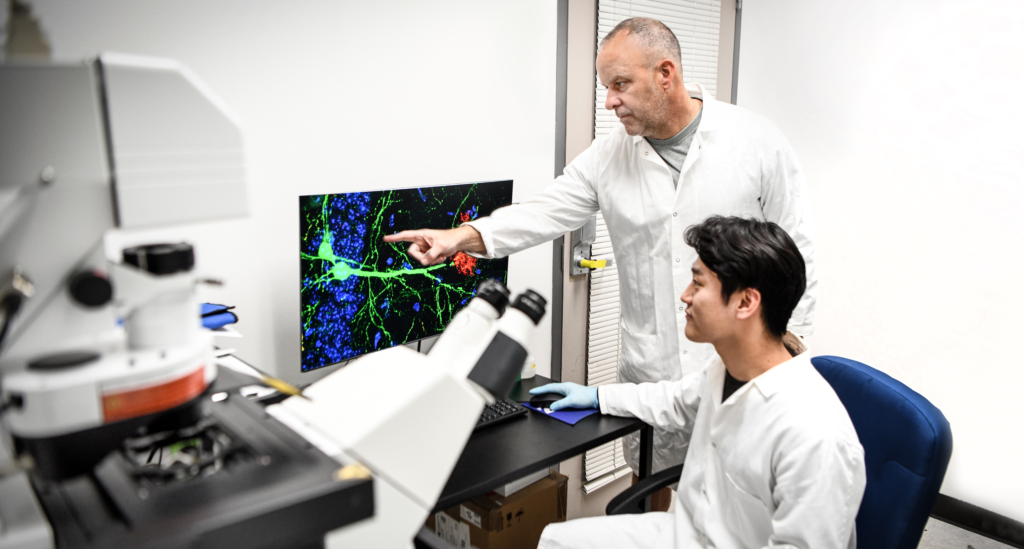
Dr. Deneen is researching astrocytes, a type of brain cell that has historically received much less attention than neurons in Alzheimer’s research. While neurons transmit information throughout the brain, astrocytes help maintain healthy brain function. Dr. Deneen and his team believe that when astrocytes become impaired, the damage can ripple through neural circuits involved in learning and memory, contributing to cognitive decline. Their work explores whether restoring astrocyte function can help preserve brain circuits and maintain memory, even as Alzheimer’s disease progresses.
What makes this research particularly novel is its focus on strengthening the brain’s support system rather than targeting neurons directly. The team is studying powerful transcription factors—genes that regulate entire networks of other genes—to reprogram and improve astrocyte function. In preclinical studies, they introduced these factors after disease-related degeneration and cognitive decline had already begun, mirroring the real-world challenge of treating patients with existing symptoms. The researchers also discovered that enhancing these transcription factors appears to give astrocytes a remarkable new ability to clear toxic amyloid-beta plaques, almost like a “vacuum cleaner” in the brain.
“These findings could open new avenues for treatment, and we hope this will ultimately lead to therapies capable of preserving cognitive function and slowing disease progression,” Dr. Deenen said.
The work is also generating new questions about how astrocytes influence brain circuits in Alzheimer’s disease, which could spur further understanding of the condition’s mechanisms and treatment opportunities.
For Dr. Deneen, support from organizations like Stop Alzheimer’s Now is essential to pursuing innovative ideas that may otherwise struggle to receive funding.
“The support provided by Stop Alzheimer’s Now is essential for us to be able to pursue these studies,” he said. “It helps fuel innovation and ‘out of the box’ therapeutic ideas by funding risky studies, and it’s that type of support that will eventually lead to more treatments and eventually a cure for this malicious disease.”
“Stop Alzheimer’s Now was founded on the belief that scientific breakthroughs happen when great researchers are given the resources to pursue promising ideas,” said Shaun McDuffee, founder of Stop Alzheimer’s Now. “Dr. Deneen’s research represents the kind of forward-thinking approach that could reshape how we understand and treat Alzheimer’s disease. Thanks to our donors, we’re able to support scientists who are asking new questions, exploring new possibilities and bringing us closer to better treatments and, ultimately, a cure.”
To make a gift to support this work, click here.