

Dr. William Cohn has been honored with the 2026 Baylor College of Medicine Alumni Lifetime Achievement Award. View the full list of 2026 Awardees and Past Honorees here.
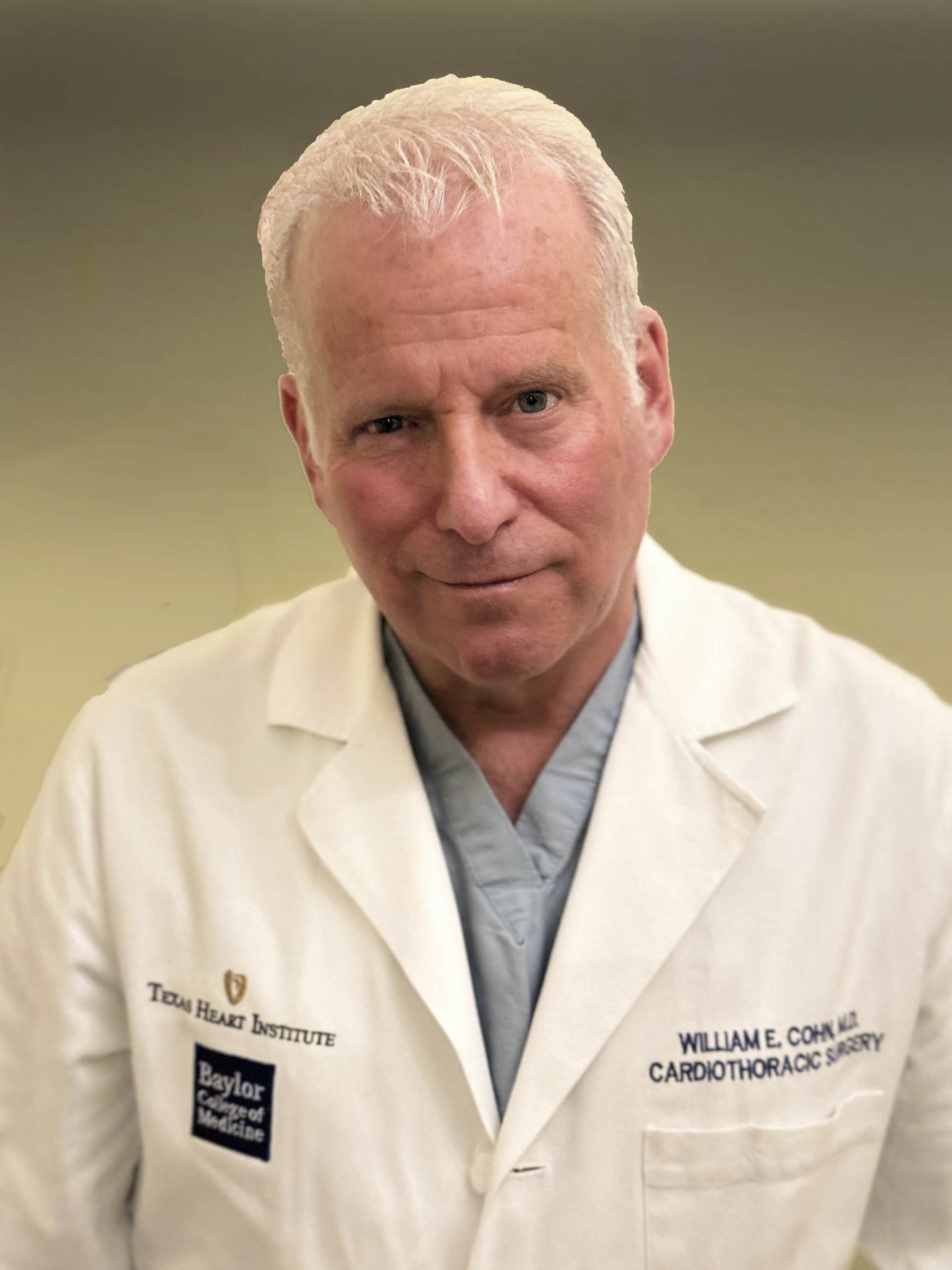
Dr. William E. Cohn is the executive director of the Medical Device Lab at the Texas Medical Center. He is a tenured professor of Surgery at Baylor College of Medicine and an adjunct professor of Bioengineering at both Rice University and the University of Houston. He serves as chief medical officer of BiVACOR Inc. and Obvius Robotics.
A native of Houston, Texas, Dr. Cohn received his undergraduate degree from Oberlin College in Oberlin, Ohio, before returning to Houston, where he received his medical school education, general surgical training and cardiothoracic surgical training at Baylor College of Medicine. Dr. Cohn is proud of the fact that he served as the last chief resident of the legendary heart surgeon, former Baylor president, chancellor emeritus and the 2006 Baylor College of Medicine Alumni Lifetime Achievement Award recipient, Michael E. DeBakey, M.D. After graduation, Dr. Cohn spent eleven years on the faculty of Harvard Medical School and as an attending cardiothoracic surgeon at Boston’s Beth Israel Deaconess Medical Center. In 2003, he returned to Baylor, where he is now an attending cardiovascular surgeon at the Texas Heart Institute at Baylor College of Medicine (THI).
Dr. Cohn’s major research interests are focused on the invention and development of new medical technology and on performing the necessary entrepreneurial activities required to introduce these novel devices into clinical practice. Many of his early career efforts centered around developing tools to decrease the invasiveness of surgical procedures. Specifically, Dr. Cohn developed the first self-retaining coronary artery stabilizer with integrated vascular control for performing beating heart coronary artery bypass without the heart-lung machine, helping make less invasive cardiac surgery possible for many patients. This device was acquired by Genzyme Surgical and enjoyed several years of commercial success.
Subsequently, he developed the NextStitch valve suture system, which was also acquired by Genzyme Surgical; the SentreHeart LARIAT for excluding the left atrial appendage, which was acquired by AtriCure; and the WavelinQ catheter-based system for creating dialysis access, which was acquired by BD. In each of these devices, Dr. Cohn made the initial prototypes, filed the foundational patents and performed preclinical and early clinical studies. Dr. Cohn also provided the initial key developmental insights for PluroMed LeGoo, which was acquired by Sanofi. Additional projects currently underway include the Anaxiom ABS device for treating obesity and the Obvius Robotic CERTA device for democratizing placement of central venous catheters. In pursuit of these efforts, Dr. Cohn has been awarded 127 United States patents and has multiple additional international patents and U.S. patents pending.
Over the last two decades, an increasing percentage of Dr. Cohn’s efforts have been directed at developing the next generation of total artificial hearts, in collaboration with his mentor and the recipient of the 2024 Baylor College of Medicine Alumni Lifetime Achievement Award, O. H. Frazier, M.D. ’67, Res. ’68, Res. ’74. Drs. Cohn and Frazier, over eight years, tested multiple configurations of rotary artificial hearts, comprised of paired investigational blood turbines, and purpose-built prototype fittings in over 60 calves at THI. Many of these calves demonstrated the ability to exercise on a treadmill despite the absence of a pulse. These efforts culminated in the 2011 implantation of the world’s first rotary artificial heart in a gravely ill human, which received worldwide attention, both in medical journals and the lay press. Although the patient only survived five weeks with the device (ultimately succumbing to advanced liver failure), it was the first use of paired rotary blood pumps to replace the heart and the first clinical example of chronic pulseless physiology in a human patient.
As a result of this landmark achievement, a brilliant Australian engineer, Daniel Timms, Ph.D., who was working on his own concept of a rotary artificial heart, was attracted to THI. Drs. Cohn and Frazier’s collaboration with Dr. Timms over the last 14 years has resulted in the development of the BiVACOR device, a computer-controlled rotary artificial heart with a single magnetically levitated moving part. The moving part is a disc-shaped rotor with impellers on each face that, when rotated rapidly, accelerate the blood. Because the magnetically levitated rotor experiences no mechanical wear, and the device has no valves or flexible membranes that can fail with cyclic activation, the durability of the BiVACOR will be significantly improved when compared to all other artificial heart designs that have been tested over the last 60 years.
As of the writing of this brief bio, the BiVACOR artificial heart has been implanted in 15 patients as part of an FDA early feasibility study. The BiVACOR device has performed flawlessly and has demonstrated that it has the potential to be the world’s first fully implantable permanent artificial heart. Although prior artificial hearts have been used successfully to support gravely ill patients until a donor heart can be located for transplantation, the BiVACOR team’s ambition is to provide a permanent implant to be used as an alternative to transplantation.
Throughout Dr. Cohn’s career, he has mentored dozens of surgeons, engineers and medical technology entrepreneurs. Moreover, he lectures nationally and internationally on “Fostering a Culture of Physician Do-It-Yourself Innovation,” in which he shows multiple examples of the humble homemade beginnings of many of today’s most advanced medical technologies in hopes of encouraging listeners to initiate their own innovative adventures.
Dr. Cohn has received multiple awards over his career, including the Ray C. Fish Award for Scientific Achievement (2026), the Earl Bakken Scientific Achievement Award from the Society of Thoracic Surgery (2024), the Susan Crenshaw Congressional Healthcare Innovation Award (2022), the Wilfred G. Bigelow Award from the Canadian Society of Cardiac Surgeons (2020), the Lifetime Achievement Award in Life Sciences from Houston Technology Center (2015), the Distinguished Scientist Award given by the St. Luke’s Hospital’s MacDonald Fund Committee (2013), and the Thomas A. Edison “Silver” Award for inventing the SentreHEART® Lariat® Suture Delivery Device (2013). He was named Outstanding Inventor of the Year by the Houston Intellectual Property Organization in 2014 and Distinguished Inventor of the Year by the U.S. Intellectual Property Owners Association in 2000. He was awarded an honorary Doctor of Science from his alma mater, Oberlin College, in 2007.
Dr. Cohn has been married to Mishaun Drever Cohn for the last 36 years. They have five brilliant, kind and empathic children (four boys and a girl!), a great dog named Andy and a cat. When he is not travelling to give lectures or teaching teams to implant the BiVACOR artificial heart, operating at THI or pursuing his innovative efforts at the Medical Device Lab at the TMC, he is a serious musician and can be found on stage at several Houston clubs most weeks as well as a dedicated (and amazingly gifted!) close-up magician.